
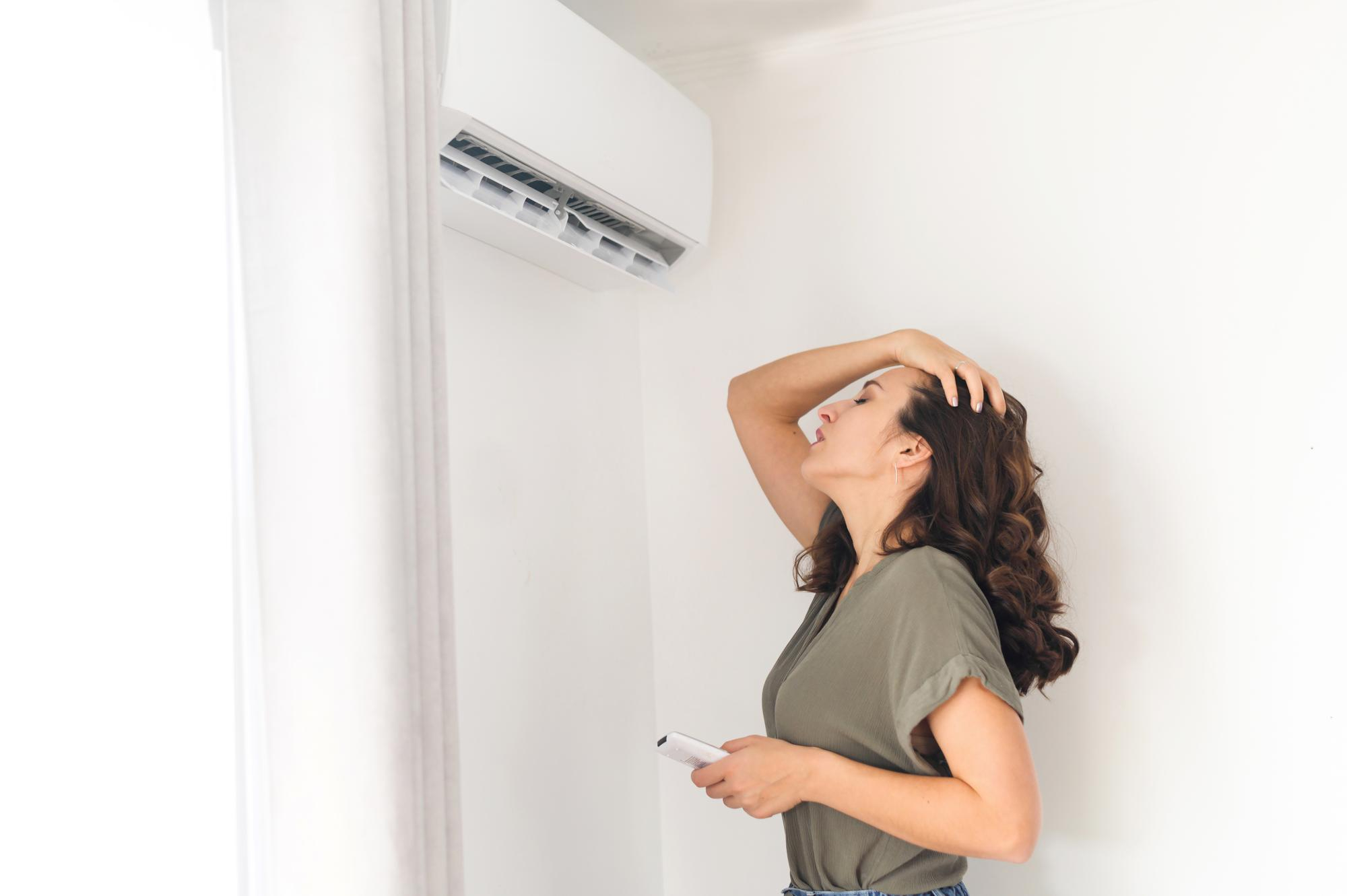
An air conditioner that runs without cooling is one of the most frequent calls we take through a Murrieta summer. The blower sounds normal, air moves at the vents, and the house keeps drifting above whatever the thermostat says.
That gap between running and cooling is where nearly every warm weather fault lives. Our team handles AC repair across southwest Riverside County, and the same short list of causes turns up year after year.
A few of them a homeowner can rule out in ten minutes with no tools. The rest need gauges, a meter, and someone who can open a live panel safely. Sorting one group from the other saves either a service call or a compressor.
Running Versus Cooling: Why the Difference Matters
Air conditioning does not manufacture cold. It moves heat from inside a building to the outside, using refrigerant that changes state as it travels between two coils. The indoor evaporator coil absorbs heat from air passing over it, and the outdoor condenser coil releases that heat into the yard.
Both halves of that loop have to work for supply air to arrive cold. Restrict airflow across either coil, or lose enough refrigerant, and the fan keeps spinning while heat transfer collapses. Air still reaches the vents, carrying the same heat it started with. That is how a system sounds healthy and cools nothing.
Seven Reasons an Air Conditioner Stops Cooling
Across residential and commercial calls, cooling failures cluster around a small group of faults. Some restrict airflow, some starve the refrigerant circuit, and a couple come down to one electrical part that costs less than the diagnostic itself. Most of them give warning before they fail outright, often by making a system short cycle on and off for weeks beforehand.
- Clogged air filter. A loaded filter chokes airflow across the evaporator coil. Output drops, run times stretch, and the coil can fall below freezing.
- Thermostat set to fan rather than auto. The blower runs without pause, pushing unconditioned air between cycles, which reads at the vents as warm air.
- Dirty condenser coil. Dust and landscaping debris blanket the outdoor coil until heat has nowhere to go. Riverside County summers coat these fast.
- Low refrigerant from a leak. Refrigerant is not consumed, so a low charge means something is leaking. Adding more without finding the leak buys weeks at best.
- Failed run capacitor. This part gets the compressor and fan motors turning. When it fails, the outdoor fan may spin while the compressor sits silent.
- Frozen evaporator coil. Ice across the indoor coil blocks airflow completely. The vents go quiet, and water appears once it thaws.
- Failing compressor. The pump at the heart of the refrigerant circuit. As it loses capacity, cooling fades gradually rather than stopping outright.
These overlap in practice. A restricted filter and a weak charge both push a system toward ice, and ice then blocks airflow entirely, so one fault often presents as another.
What You Can Check Before Calling a Technician
Start at the filter. Pull it, hold it to a light, and replace it if the light does not pass through. Confirm the thermostat is set to cool with the fan on auto, and fit fresh batteries while you are there.
Check the panel for a tripped breaker, then step outside and confirm the condenser fan turns when the system calls for cooling. Finish by checking that supply vents and return grilles are clear.

A thermostat misreading the room produces exactly the same complaint as a mechanical fault, which is why thermostats that will not hold temperature are worth ruling out before anything gets opened up. If all of that checks out and the house still will not cool, the fault sits somewhere that needs instruments to see.
Ready to get it diagnosed? We work across Murrieta, Temecula, Menifee, and Wildomar, and into the Los Angeles, Orange County, San Diego, and Riverside markets. Send us a message, and we will schedule a visit.
How We Diagnose a Cooling Failure
Our technicians work the system in order rather than guessing at parts. We confirm airflow at the return and supply, then measure the temperature split across the evaporator coil, which shows whether the fault sits on the air side or the refrigerant side.
From there we inspect both coils, read operating pressures, and test the capacitor and contactor under load, since a part that reads fine at rest can still fail when the compressor tries to start.
Once we know what failed and why, we say plainly whether the repair is worth making or whether the money is better spent on replacement. That assessment comes before any work begins, not after.
Age, repair history, and the cost of the fix all feed into it, and signs your condenser needs replacing often show up months ahead of a total failure. The same team handles heating, ventilation, and heat pump work, so a cooling call that turns out to be a ventilation problem does not need a second contractor.
Frequently Asked Questions
These are the questions homeowners raise most often once a cooling problem shows up. Each answer reflects what our technicians find in the field rather than general guidance.
Continuous running with poor cooling points to reduced capacity rather than a dead component. A dirty filter, a fouled condenser coil, or a low charge all force the system to run longer for less result. If it never satisfies the thermostat, have it checked before the compressor takes the strain.
Yes. Running a system that cannot cool risks compressor damage, and if ice has formed on the indoor coil, continued operation makes it worse. Switch the cooling off, leave the fan on auto, and let any ice melt fully before a technician arrives.
Not on its own. Refrigerant only runs low when there is a leak, so the question is where it sits and what the repair costs. A leak at an accessible fitting is straightforward. A leaking evaporator coil in an older system is where replacement starts to make better sense.
Contact Us
If the house is not holding temperature, we can find out why. Reese Mechanical Inc. is at 26217 Jefferson Ave., Murrieta, CA 92562, open 7:00 AM to 5:00 PM on weekdays. Email admin@reesemechanical.com or use the contact form on our site to request a visit.
Related Topics: